I think this is an terrific article by one of the people I consider to be among the brightest contemporary american thinkers. Thanks to John Barach for the link.
I was especially interested in Peter's comments on charity. This is something I had begun to learn and am still trying to grasp in studies of the ancient world. The notion of "love" or "charity" was, I think, entirely different than our current ones. The ancient world, and many parts of the non-western world today I believe, are characterized by an amazingly tenacious group loyalty. This apparently existed to the extent that people always thought of themselves in terms of the group they belonged to--their parents, ancestors, tribe, village, and possibly profession. Of course the dark flip side of this is a rather strident xenophobia. Anyone from outside you family is a possible enemy. If they are from outside the nation, take out the "possibly".
In this context the satements of Jesus in the gospels seem all the more striking. Jesus proposed that these ties, ties which constituted people's basic notions of who they were (ancestors, laws, traditions, families), were to be considered done away with, no longer of primary importance, and that he would be their new family, their new law, and their new nation.
Tuesday, September 14, 2004
My brother introduced me via email to one of the classics professors at Purdue. It's been fun interacting with him. One of the pleasures and pains of being a dilletante like me is that you can get into conversations with folks in lots of different felds but always feel like something of a fake. When I've read three or four books on a subject and talk to someone who has devoted thier career to it I feel like a kid talking to an adult. I'm keenly aware of how little I know. I guess kids don't always feel that way though.
Sunday, September 12, 2004
I have finished all of the submitted contest books and will put up a couple more reviews tomorrow. I'm afraid I'll have to reneg n my promise to pick a winner though. It's just too hard. I will try to send out prizes to everyone though in either the order that I liked your submission, or when you send me your wish list (or info about how to find your wish list). BTW, you cannot simply go to your amazon wishlist and copy and paste the url there. Doesn't work, trust me.
Saturday, September 11, 2004
The Mebane Public Library has a perpetual library sale of donated books they have no room for. I stopped by last week on the way to the grocery store and saw a new stack of books there. I poked around and found a bunch of (OT scholar) Walter Bruggeman titles and a couple other things. On my way over to the videos I noticed a couple of VERY large hardcovers with somewhat damaged boards. I decided to take a look. It was bothe volumes of the compact edition of the OED. Total price for all the books I could carry was $10.
Today was the first day of the county seat library sale. I popped in for a while of course. Prices were not quite as good as in Mebane. $3 hardcovers, $1.50 for soft. Fortunately everything not hardcover was considered soft, so I got Norman Davies Europe: A History and Michael Chabon in trade quite cheap, and a Robert Penn Warren novel for free in the stack by the door.
Thursday, September 09, 2004
This is from the department of things-we-have-known-for-a-long-time-but-journalists-are-just-now-figuring-out.
Book contest updates.
Finished reading Lilith. I wish I had something really intelligent to say about it, but I don't. Certainly a magical novel, and certainly you can see where the influence for Lewis' Christian neo-platonism comes from here. Some of it worked well for me and some didn't. I fear in some sense this may be due to lack of concentration on my part. Despite all the reading I do, I'm still someone who grew up on tv.
Yesterday I finished It Happened in Boston?. Here's a book which contains its own handy summary, which I will reproduce at the risk of "giving it away".
The book had much of what I love in a novel: a wondrous main character, odd plot, and a shimmering and imaginative use of nearly every word in the dictionary. And yet, I am compelled to compare it to another book about art forgery, Robertson Davies' What's Bred in the Bone. This is certainly unfair. Davies book was written twenty years later and he may in fact have read Greenan. But it is impossible for me to avoid thinking that Davies' novel comes out better in comparison. But I did enjoy reading Greenan's book as well.
Book contest updates.
Finished reading Lilith. I wish I had something really intelligent to say about it, but I don't. Certainly a magical novel, and certainly you can see where the influence for Lewis' Christian neo-platonism comes from here. Some of it worked well for me and some didn't. I fear in some sense this may be due to lack of concentration on my part. Despite all the reading I do, I'm still someone who grew up on tv.
Yesterday I finished It Happened in Boston?. Here's a book which contains its own handy summary, which I will reproduce at the risk of "giving it away".
But what was I give? A faithless, empty headed, burglarious woman for a wife and a conscienceless, philandering English phlebotomist for a business agent. This precious pair of vipers began it all. These two adders divided my life, subtracted my happiness and multiplied my misfortunes. It was they who tipped me into that maelstrom of flse marcheses, mercenary Bergamese whores, slippery Italian counts, witless German art experts, villainour Peruvian generals, paranoiac harpies, spiteful Russian cats, specious Polish wizards, spying pigeons, nosy janitors and ambitious Irish cops. My closest friend was driven to hang himself by my closest enemy. Somehow, through cunning insinuation and obscure machinations, I was inveigled into murdering six poor strangers and the kind and generous Leo Faber--in the name of humanity! I have been slanderd, lied to, cuckolded, robbed and persecuted. My lovely reveries have been snatched from my head and replaced by nightmares. The fruit of my years of labor--enough beauty to stock a museum--has been carried off to a foreign land, while one of my masterpieces has been plagiarized by a man dead five hundred years. I've been thwarted by an angel, duped by God and stalked by the Devil. Who would believe such things could happen in Boston?
The book had much of what I love in a novel: a wondrous main character, odd plot, and a shimmering and imaginative use of nearly every word in the dictionary. And yet, I am compelled to compare it to another book about art forgery, Robertson Davies' What's Bred in the Bone. This is certainly unfair. Davies book was written twenty years later and he may in fact have read Greenan. But it is impossible for me to avoid thinking that Davies' novel comes out better in comparison. But I did enjoy reading Greenan's book as well.
Thursday, September 02, 2004
I'm sure this would be a better blog if I wrote something once in a while.
I'm onto part two of the 2004 Book Recommendation Contest (may do links later if I feel energetic). Just finished reading The Undertaking by Thomas Lynch. Really quite a good book. he certainly knows how to write and has a lot of good things to say. Most of his issues are ones I've thought about myself at some point, including some of the stranger topics. For instance I once though about getting into the buiness venture that his uncle Eddie tried--messy suicide and death cleanup specialist. Eddie was horrified when Dr Kevorkian became active. He was sure that this would ruin his business as all the suicides would be clean and tidy. I think I must have a dark sense of humor as I found that pretty funny.
Now I'm off to pick up and look over a curriculum for teaching the high school group at church. I'm pretty concerned about the nearly total ignorance of the Bible I'm finding among this group, so I'm hoping to do some basic level instruction in that area. I'll be glad to have some organized material to fit this into or around though. I'm always full of ideas and love teaching, but I'm pretty bad at organizing a curriculum from scratch.
And in other news, got an email from the pastor in Lviv. They will be starting a big English class next week. They expect 300 participants. Many of their folks will be called on to teach for the first time, so they are nervous about that, which is completely understandable. Maybe I need to pass on to them some of the things I learned about teaching?
Friday, August 27, 2004
There's nothing like the smell of boiled buckwheat to bring back some memories of the Carpathians. Too bad the stuff doesn't taste better, as apparently it is quite healthy.
Thursday, August 26, 2004
It's always nice to hit a random livejournal page and see something I recognize (in the top picture, that is).
We watched the Ian McKellen version of Richard III tonight. This was one I had picked up at Big Lots for 2 bucks. What an extraordinary film. I had never read the play, so I had no idea what to expect other than the horse line--which came accross oddly in this version as Richard was in a jeep at the time. It's amazing now to me that England ever survived through that period.
Tuesday, August 24, 2004
I am now officially a piano teacher! I had my first student today and had a great time. I'll have two students next week as the neighbor family signed their daughter up as well. So far the only thing I feel odd about is my lack of familiarity with the standard curricula. That and the fact that most of the instructional books are, by consensus, not that good anyway. But anything is useful to start with. My first student is a very bright young lady. I was impressed already with her knowledge of basic theory and reading ability. Time to kick it up a notch I think :)
[edited for finicky people who prefer words to be spelled right]
Saturday, August 21, 2004
Cute Olympics coverage mess-up story here. Make sure to scroll down in the comments to see the newspaper article my my friend, David Frauenfelder.
Wednesday, August 18, 2004
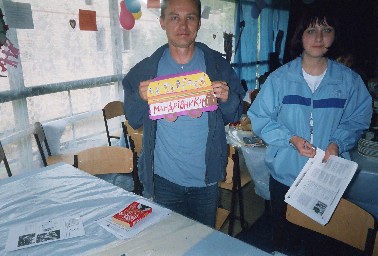
Here's Yaroslav holding the "friendship bus". this was pretty funny to me since he was always a little grumpy and cynical, but he wanted me to take this picture. Lilia is next to him. Lilia missed about half the week, but was a member of the church and seemed to know everyone. She was one of our tour guides in Lviv.

I've been kind of bummed about how slow my business has been lately, but perhaps there's a silver lining. I've decided to start teaching piano lessons. Yesterday I found my first student (and have at least 3 more who are intersted in talking about it). I've always liked teaching, but I've never taught piano before, so of course I'm a bit nervous about how I'll do. There's the balance between being too nice and being too pushy. The parent I met yesterday said her daughter had 2 teachers already. The first (and this is someone I know) was kinda pushy and discouraged her. The second was a group class which was so easy that the mother thought her daughter actually retrogressed. I think I'm capable of walking this line, but I guess I'll find out in practice soon enough. I think adult students would scare me less because I wouldn't worry so much about hurting their feelings. If an adult wants to pay for their own lessons, I expect them to be somewhat self-motivated and I imagine they want to be challenged rather than coddled.
Which brings me around to
Lessons from Ukraine part three:
My brother, the real academic scholar, encouraged me to make a journal of what I learned about teaching English. I did a little bit of this, but not as much as I had hoped before hand. I certainly found our three hour training session on Aquiring a Second Leanguage to be extremely helpful and reviewed my noted from that class during my week of teaching. Since I was teaching advanced students, I tried to teach them some of tht same material, since many of them I knew would also be involved in teaching English at some point.
One helpful thing, though small, was the use of a two hand model from prounoucing certain sounds. Native Russian and Ukrainian speakers have a lot of trouble with the "th" sound. If you use your hands, one to model the upper palate and teeth and the other to show the position of the tongue, it is very easy for students to see how to reproduce a sound. One of them also gave me the tidbit that for that particular sound, the person you are speaking to should be able to see your tongue.
The issue of how and when and how much to teach pronunciation was interesting to me, Dean Storelli, our ESL instructor, said we should not spend much time on it and not do any until after building some repore and listening carefully to the students. Most pronunciation, I suppose, gets picked up naturally through speaking and listening, and drills get boring and discouraging, and don't simulate real conversation. I did notice several in my class having problems with that particular sound, so we did work on it for five or ten minutes on the fourth day of class. One student in particular (Yaroslav) had learned most of his English through reading. His knowledge of vocabulary was excellent, not to mention that he was quite insiteful in many ways due to having such an inquisitive mind, but his pronunciation was horrible. Perhaps it didn't matter that much to him, since his English interactions were more textual than personal.
One comment that surprised me, and I heard it from more than one student, is that they liked learning English because it was "easier" than other languages they had studied. I think German was the next most common foreign language for them, and they found it difficult. I don't know why they felt this way, but it doesn't matter that much. It's good to know that some find English simpler to learn.
One of the things I found out about myself through teaching was that I'm not very good at trusting others with tasks. We had a lot of exercises in our text book that required the students to either work by themselves or with each other in small groups. I always felt hesitant about doing these since I felt like I needed to maximize my time in teaching them. Also since many of the students were not really close with each other, they were hesitant themselves about working in groups. I knew this sort of thing was necesary though. I knew that after I left, they would be getting most of their English practice with other Ukrainians and not Americans. One of the exercises was for the students, in gourps of four or five, write a horror story together. They had a list of possible story elements and settings in the text book. I gave them about twenty minutes. After about ten, I noticed them really working together well, which was very exciting for me.
The next day after that, I read to the class an interview with Graham Greene. It was a listening comprehension test of sorts. As I did it I started feeling the opposite of how I had before--the class was spending too much time listening to me and not practicing speaking enough. I guess it has to go back and forth a bit.
Monday, August 16, 2004
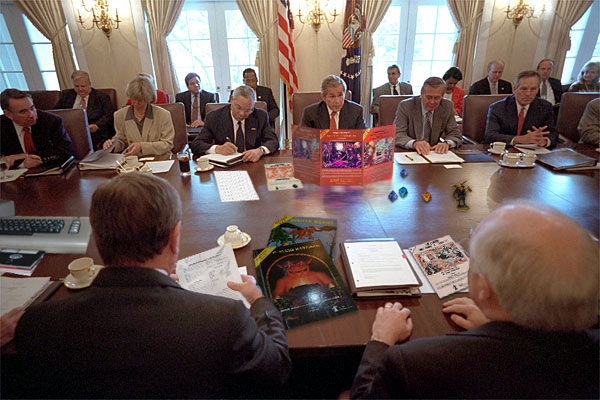
I believe I already issued my own warning about one of these words. And speaking of words, I've been reading Word Freak lately. This is one of the most interesting and disturbing books I've ever read. It's a rather deep look into the world of tournament scrabble players, a world which seemed to suck the author right out of any semblance of normal humanity. When you click the link above, be sure to read the first reader review, esp. the title. The author of that review is one of the major characters in the book, known to his friends as GI Joel. Please don't ask me why, just read the book.
Sunday, August 15, 2004
I've been thinking of lots of blogworthy things in the last several days, but my energy level when I have been at home has been pretty feeble. No good reason for this aside from me being lazy. To break out of the rut, just a few recent thoughts about music, starting with,
Lesson Two from Ukraine.
One of the many things I respected about Tabernacle Church of Lviv was the way they used their musical equipment so efficiently. They had one man (I never learned his name) who took care of all the sound equipment, one young man (who was not quite sure yet if he was willing to commit to Christ) who played the guitar pretty well, and one woman who had one of the $200 type Yamaha keyboards. The latter is what caught my attention. I've been a fan of keyboards for a long time, and I know that a lot of time and engineering has gone into these keyboards, even at that price level, to make them flexible for different types of music and easy to work with. For all that, I have never once seen one of these keyboards used to its potential in any sort of public music performance in America. This woman, though, found the best style settings for each praise song we sang and was familiar enough with the controls to do a really fine acompaniment job for us. I know that most of that is not especially difficult. Finding the appropriate style setting is the hard part. After that its mostly just playing basic chords from a lead sheet. But for some reason no one in our fine country has ever seen the need, in my presence, to use such a well designed tool to fill out a small music leading ensemble.
In other news, and I'd be surpised if even one person cared about this one, I was listening to the radio and heard a fascinating piano piece. It was all over the keyboard, it was difficult, it was beautiful, and it sounded strangely like J S Bach. Knowing that Bach did not write for the modern piano and thus did not write anything that would be played in that style, I surmised it must have been a late romantic or modern composer who had studied a lot of Bach or was writing a set of variations or something like that. Turns out I was close. It was a Busoni transcription of a Bach fantasy for violin and orchestra, IIRC. Busoni, for those who don't know, made a career out of doing exactly that sort of thing--trancribing Bach pieces for modern piano. Quite a pianist and composer in his own right as well.
On a similar note, I heard a couple of months ago a transcription of a Bach organ fantasy by Elgar. I thought it was just as good as anything else I'd heard from Elgar. I think Bach is similar to Augustine and Aquinas and Barth, and perhaps Calvin in theology. You could never hope to comprehend their life's work, but you really do need to start somewhere and see what you find.
Thursday, August 12, 2004
In honor of all my Ukrainian friends, I made a big pot of borsch last night. If you haven't tried it, a good borsch is as good as any soup out there. The beets I got were white beets, so mine doesn't have that wonderful blood red color, but the tase seems pretty comparable to what I had in Ukraine. Will share recipe on request.
Monday, August 09, 2004
I think England has now gotten their priorities straight. I knew something had been missing over there for a while. Just couldn't put my finger on it.
I see some discussions from time to time about how we as Christians can get along when we disagree. This looks like a very interesting take on the subject, though I haven't read it through thoroughly yet. I like the title at least.
Sunday, August 08, 2004
I'm fascinated by the research reported here (it's several paragraphs down). I suppose one could consider this objective proof that scripture does not interpret itself.
Saturday, August 07, 2004
I was reading a little discussion of Christian support of arts and culture (or lack of said support) over at jon's blog, and it got me thinking about a couple of things I saw this past week. I was in Vienna from Sunday night til Wednesday morning. Quite a lovely city, and one where you can walk anywhere, and anywhere is worth walking to--I didn't find any "bad" neighborhoods in my constant wanderings. Anyhow, at one point I remember suggesting to one of my companions that I'd heard about a cool concert that would cost about eighteen bucks to get into. She said for that price she'd rather get a CD she could listen to over and over. I don't say that to embarass her, but rather to point it out as an example of how american typically view culture these days, i.e. something that can occur in the privacy of one's home.
To continue with the narrative, though I never did figure out where that particular concert was being held, we did attend the Vienna summer film festival showing on Tuesday night. That particular night was a concert from St Petersberg from a few years ago. There were probably a thousand people there watching classical music on a giant screen, not counting those who just came for the food and beer. I was trying to imagine how such an event would go over in the US. First of all, they wouldn't serve beer at a state sponsored event. Second, they wouldn't dare attempt to show something with such limited appeal as classical music. Third, people would be asking if they could get a live webcast they could watch at home.
I think perhaps we have become so enamored with our technologies that we are willing to substitute iamges for the real thing. We can control when and where and with whom, if anyone, we play our CD's and our DVD's. Thus we don't need public culture. And thus our souls grow smaller and our recliners grow bigger. Thus we don't need to learn to make music. We can simply push a button and hear the finest musicians in the world.
It's my website and I'll rant if I want to.
Friday, August 06, 2004


I tried putting up a big post yesterday, but it got swallowed into the ether. Save me the advice about how not to let that happen. I have to learn from my own mistakes somehow.
Anyway, I think it will be better to break up what I wnted to say into several posts and expand a bit on them. The general topic is "what I learned over the last two weeks." Sounds like an 11th grade paper, doesn't it? I don't think it is possible to organize these in any coherent way, but if you were looking for coherence, you wouldn't have come to my site in the first place.
My first lesson from Ukraine is that american don't know the meaning of the word "creative." In the seven days we were at the camp in the Carpathians, we must have seen forty to fifty skits performed, most of them written that same day. The skits often involved handmade props and ad hoc decorated signs. We also saw several puppet shows (there were a number of kids present), had a cake decorating contest, made table decorations, and had one night where people had to illustrate bible verses in their hair.
This isn't all be any means. The dining hall was heavily decorated. There was a contest for best door decorations for our dorm rooms. There was a "scret angel" program--just like "secret santa"--but I felt woefully behind as I gave my person only four gifts while I received about a dozen. Woefully behind is how our whole team felt throughout the week as we watched folks shouting out chants during meals--some sort of four line iambic version of "bon appetite" in Ukrainian, rendered by the teen crowd, spawning further counter rhymes by the other tables.
I think perhaps the process of the destruction of the western mind by tv and other media is much closer to completetion than I had realized. The response we got for our meagre efforts to participate in all of this seemed much like how our beginning level English teachers would respond to their students. "Wow. You are doing great! In no time you'll learn how to write your own skits. Just keep at it. In a few years, with hard work and some luck, perhaps we won't even be able to tell you are americans."
Sunday, August 01, 2004
Thursday, July 22, 2004
Leaving for the airport in about half an hour. Managed to get about half a night's sleep, which I think is pretty good before taking an exciting trip. I hope I'm able to get some rest somewhere along the way. It's probably good that we'l get to Lviv in the evening, local time, Friday, as we'll be able to get rest shortly after we arrive.
Wednesday, July 21, 2004
Tuesday, July 20, 2004
I keep feeling I should post something. I've gotten into a few controversies on other folks sites, but nothing new or noteworthy. Just stirring up some pretty old arguments.
Thurday morning I leave for Lviv for the prupose of teaching English classes and participating in Bible discussion groups with professional and academic Ukrainians. In preparation for this, our team had a meeting a couple of weeks ago with Dean Storelli who teaches people to teach ESL at Duke University. We got to learn about Stephen Krashen and some of the newish ideas regarding aquiring a second language. It was all enormously helpful and I look forward to telling my (andvanced level) students about what I learned.
The theme that the staff in Lviv picked for the week is "friends for a lifetime." I'm not sure what they are planning to do with that, but I found I had two books on my shelves on the subject of friendship, so I read them this past week.
The Friendship Factor is one I read about ten years ago but it was good to dust off and read again. I ws amazed at how much had stuck with me along the lines of "oh, THATS why I started doing that." It's a very practical and pragmatic book about how to cultivate, deepen and maintain friendships.
The other was Becoming Friends by Paul J Wadell. This is a more philosophical book by a Notre Dame educated Catholic. What really stood out was the chapter on Aelred of Rivaulx, a 12th century monk from Northumbia. Aelred studied the relaionships between the Cistercians at his monastery and decided there were three types of friendships. Carnal friends are those who are drawn together to participate in evil together, such as gossip or drunkenness. Worldly friends are those who hope to gain some advantage from their fiends. And Spiritual friends are thsoe who are joined due to their commonality in Christ. There's lots to explicate there, but you get the general idea.
I think its about time to head out to our last team meeting before we leave. Pray for us, if you would.
Sunday, July 18, 2004
My brother has taken it upon himself to make sure we are stocked with quality films at our house. We watched two that he sent us in the last two nights. Last night we watched Butch Cassidy and the Sundance Kid. A good fun flick. One thing I picked up. One of the unseen lawmen chasing the eponymous pair was called Laforce (sp?), the greatest lawman in the West who always wore a white straw hat. Anyone remember which movie referenced that?
Tonight we watched Network. If there was a better movie made in the 70's I'd like to know. It was an amazing job of keeping up a darkly humorous tone through a film on a relatively serious subject. The writing was absolutely masterful. I can't say much more in the spirit of the film without cussing, so I'll leave it at that.
Saturday, July 17, 2004
I have a new obsession. This site just puts up the last 20 or so images people posted to livejournal pages. Some degree of this will be unsafe for work/children, but that can't be predicted in any way. Just a weird way to see random pictures.
Friday, July 16, 2004
Breaking Chess news. Seriously. (Sorry, link apparently dead now.)
Ok, dumbed down version on ABC here.
Thursday, July 15, 2004
Tuesday, July 13, 2004
Voting With Our Feet?
Just looking over these numbers, there's something I noticed. The states predicted to vote for Bush have gained eight electoral votes elative to the states predicted to go to Kerry. Just to complete that, the undecided ones have lost two. Are republican states better places to live? Do they just have more kids there?
On that last point, I remember seeing some analysis recently on the affect of abortion on voting. An ever larger number of aborted children since Roe v Wade would have been of voting age, and a disproportionate number were aborted in places that vote more often for the democrats. I guess it doesn't pay to kill off your voters.
Monday, July 12, 2004
Over on the "big Lutheran blog", as I'll call it for now, Josh et al have been trying to point out why they think Calvinism stinks and all of us should become Lutherans. At some point it got into views of politics and I mentioned in a comment (I don't even remember under which post, sorry) that I was completely ignorant of Lutheran views on politics and would love to hear something about them. Thus is was something of a surprise to me to see bubble to the top of my reading stack a volume I'd forgotten I had, God and Caesar, a collection published by Augsburg back in 1959. Apparently there had been some regular symposium on religion and politics at Valpo in the 50's, moderated by Princetonian Otto Piper.
Having gotten most of the way through this, and assuming that it represents both typical and well-expressed Lutheran views, I would have to say that they win on this front. The Calvinist concepts of positive law seem to me to fundamentally twist the attitudes of their adherents. Not that I wish to downplay the role of the law within the scripture or to endorse the Lutheran views of law and gospel, but the american Calinist tradition, through theology and historical situation, teaches that we have to create our own society and law embodied in a just state; and while that is certainly a noble sentiment, it seems rather different than what the NT teaches us about how to act as a follower of Jesus on this earth. As Hauerwas likes to say, the church doesn't need a politics, it IS a politics.
Friday, July 09, 2004
Wednesday, July 07, 2004
From time to time I think about what I would like this blog to be, other than just getting me some practice writing. If I'm honest with myself, I realize that what I really want is legions of adoring fans. Thus I always feel a bit humbled when a post only gets comments from my wife and my mother. I want to see dozens of people writing in saying, "There was more wisdom in the second sentence of your post than in the last three generations of my family combined." Which means I want to attract flatterers with no sense of shame or honesty I suppose.
A couple of weeks ago I got invited to play a part in a VBS play. I had taken a drama class back in HS, but never got a part in a play. That's probably for the best, since I enjoy acting WAY too much. I don't need another narcissistic pursuit in my life.
Anyhow, the VBS play was based on two kids and a time machine. The particular day I was involved they were summoned to a courtroom to decide if Jesus was a prophet or a priest or a king. I was the bailiff, the formerly blind Bartimaeus. My friend Brian was the judge, and some others played Peter, John, and the widow from Nain (the witnesses). Brian's wife, Brenda, was running the show an told me to have as much fu as I could with my role. Brian told me the judge would be a cross between Shelby Foote and Freg Gwynne's character from My Cousin Vinny. I figured that gave me some license, so I went with something like a Scatman Crothers character. It seems I was a big hit with the kids. I guess that's just because I was loud and goofy. Probably the same reasons my wife keeps me around. Brian and Brenda and thier two boys, btw, are coming with me to L'viv in two weeks. Should be fun.
Friday, July 02, 2004
i wonder if there's much objective difference between web personality tests and horoscopes. For instance, I took this little one, and found myself smiling at the flattering results:
But surely everyone gets a flattering result, don't they? I suppose The Paul Begala thing bugs me a little, but at least we share a name.
You are a WRCF--Wacky Rational Constructive Follower. This makes you Paul Begala. You are unflappable and largely unconcerned with others' reactions to you. You were not particularly interested in the results of this test, and probably took it only as a result of someone else asking you to.
You have a biting wit and intense powers of observation. No detail is lost on you, and your friends know it--relying on you to have the facts when others express only opinions. You are even-tempered, friendly, and educated. Foolish strangers may mistake your mildness for weakness--they will be surprised.
You entire approach to life is enviable. You will raise good kids
But surely everyone gets a flattering result, don't they? I suppose The Paul Begala thing bugs me a little, but at least we share a name.
Discovered an interesting blogger this week who has a nice post on a dear topic here. I suppose we all have our own distinctive ways of saying what Tim is saying, but it seems generally on the mark.
Wednesday, June 30, 2004
Tuesday, June 29, 2004
Monday, June 28, 2004
Back when many of us were discussing Mel Gibson and the issue of portrayals of Jesus I had asked a few times how people interpreted Galatians 3:1
The last time I wrote to Stan Hauerwas, I asked him, among other things, for his thoughts on TPOTC. I like his response:
You foolish Galatians! Who has bewitched you? Before your very eyes Jesus Christ was clearly portrayed as crucified.
The last time I wrote to Stan Hauerwas, I asked him, among other things, for his thoughts on TPOTC. I like his response:
I didn't think Mel Gibson's "The Passion of the Christ" was as bad as most people thought it was. My deepest problems concerning the movie are about whether film is a medium that appropriately embodies the Gospel. We become spectators to violence, and I don't think that's what the gospel wants us to be. I thought also the separation of the Passion from the life is always a problem. I made the point [not sure where] that the medium is not appropriate to the Gospel, and was asked what the appropriate medium is? Of course I said the liturgy. That just seems so obvious but people seem to miss it.
Sunday, June 27, 2004
Had a very fun (role-playing) gaming session last night with Tom, David and Todd. Todd is quite the stickler for historical details. The highlight of the evening, after we had vanquished various monsters and three of the four serpents guarding the tower containing the obligatory princess, was the serpent of riddles. We had three riddles to answer, all of which came from a vulume entitled The Earliest English Poems. The riddle were, in fact, pretty hard, but we managed to come up with all three, though of course with a few clues from the GM.
Today our Ukraine team and the team from our church heading to Peru were something of a focus for the church. We were officially "commissioned" during the morning service, and in the evening there was a special prayer meeting for us. Lots of loving concern was expressed about Lenise and her care while I will be away. It's great to be at a church that loves us so well.
Friday, June 25, 2004
Wednesday, June 23, 2004

Tuesday, June 22, 2004
My theory is that if EVERYONE is buying a certain book, there must be something wrong with it. Looks like I was right in this case.
Saturday, June 19, 2004
For those who have not seen this yet, John Frame's article, Machen's Warrior Children, spells out pretty evenly the majority of the controversies which have afflicted the reformed and presbyterian denominations of america over the past seventy years. Take a peek.
Wednesday, June 16, 2004
I put up some of my reading from this year on amazon lists. I'd like directly, but amazon links often defeat me. I'm sure you know how to find me there. A few things didn't make it. I read a few early 70's sci-fi anthologies which I didn't even bother looking for. The rest of the Patrick O'Brian series will have to wait for the next list. You might notice I put up a couple of books where I read somthing different by that author but amazon didn't list the book I read. Also not making the list, and not listed at amazon are J S Mill's Ethical Writings, and a collection of four plays by Giradoux which I enjoyed quite a bit.
Monday, June 14, 2004
I've thought of several things to post in the last couple of days, but I keep thinking that some things are left better unsaid. I think I can say this: we had a meeting at our church last night to discuss a very difficult situation. Being a conflict-avoider person, I was dreading this meeting and thinking about not going at all, but good sense won out and I showed up. By the time I left I was thinking that this may have been the best meeting of any kind I have been to, in terms of people being honest and kind and thoughtful and wise. I am so thankful to be part of a church that has it's head on straight. I had envisioned all sorts of dreadful things, none of which transpired. I'm pretty sure only one reader (Daniel Kirk) actually knows anything about this (since he was there too) but it would be fine if we kept it that way.
I have really been fighting the urge to gossip about this. I don't think of myself as being very prone to gossip, but sometimes when you learn something bad, you you feel this incredible desire to start unburdening yourself. Talking about things in the right time and right place and with the right people, as I alluded to above, can be wonderful. Talking (talebearing) in the wrong way brings unnecessary destruction and misunderstanding.
Saturday, June 12, 2004
Due to the generosity of my brother, we received a copy of the John Wayne film, Red River, and do to the gentle but repeated prodding of said brother, we decided to watch it last night.
Like the old Gary Cooper movie we also saw recently, Fighting Caravans, Red River is a rather unromantic look at the "old west." Wayne plays the very determined and very violent Thomas Dunson, a man who builds the first big cattle ranch in Texas with his "own two hands". A rather young Montgomery Clift plays his protege, Matt Garth. Together with their team of ranchers they move their now large heard northward to sell in Missouri. Most of the film takes place on this journey.
Wayne's character knows there is a railroad in Missouri and is determined to head there at any cost. He signs the men up, telling those at the ranch that if they any reservations they may stay home, but he won't put up with any quitters. A few stay behind to tend to their families. Not long after the group heads north, some dissension breaks out over whether it would be better and safer and perhaps quicker to take the cattle to Abilene, Kansas. Since neither Mr Dunson nor any of the men present have seen the railroad in Kansas with their own eyes, Dunson refuses to credit the existence of a railroad there and annouinces that they will go to MO as planned. The dissension leads to Dunson shooting three of the dissenters.
Wayne's continued hard headedness eventually leads to a sort of mutiny with all of the men and catlle heading to KS, leaving Dunson with a couple of horses and the promise of revenge. The spectre of this revenge haunts the men all the way to Abilene. In the climax of the film the cattle are sold and at the very end Dunson and Garth are reconciled through the intercession of a woman who has fallen for Garth. Dunson acknowledges that Garth is the son and heir he never had and is unable to kill him.
The ending, while being sensible and "happy", seemed somewhat out of character with the dark tone of the rest of the film. About half way though I realized that this movie was essentially a political story of the most basic, Hobbesian sort. What is it that holds men together in society with each other? Is it personal loyalty? Fear of violence? Fear of outsiders? (Indians in this case) Working together to acheive some goal? All of these were shown and tested in this story in rather vivid ways.
Go watch it for yourself and let me know what you think of it.
Wednesday, June 09, 2004
Last fall I stopped by the Chapel Hill Public Library booksale and ended up with a paper grocery bag full of books for $3. As I took them home I wondered to myself if I had just picked these up because they were cheap or if they would actually be useful and stimulating. The bulk of what I got were sci-fi anthologies and novels from the early 70's. I've read a few of these and found them interesting more often than not.
Among the non-fiction I picked up, though, I have found some real treasures. I mentioned a few weeks ago Will Campbell's book, Race and the Renewal of the Church, which was excellent. This week I read a collection entitled The Philosophy of History in Our Time, ed Hans Meyerhoff. The essays in it are from the most thoughtful historians and philosophers who wrote about history from roughly 1880 to 1950. These would be Dilthey, Croce, Ortega y Gassett, Collingwood, Pirenne, Toynbee, Becker, Beard, Lovejoy, Aron, Dewey, (Morton) White, Nagel, W H Walsh, Butterfield, Berlin, Burckhardt, Bullock, Popper, (Reinhold) Niebuhr, and Jaspers. Nearly all of the essay were intriguing to me, exploring the questions of whether history has meaning (of its own), what one studies when one studies history, etc.
One section I found particularly striking was this by Karl Popper (somewhat edited to save space):
He goes on to explain that last phrase for about 3 pages, so I won't burden you with it now. The jist of it is that identifying God with "history", as the term is normally used, puts God into an unholy alliance with power and evil. He points to the sufferings and crucifixion of Jesus as the opposite of what we mean by history.
* Popper uses this term to mean the idea of a unified meaning of history according to a theological or rational law or set of laws, which is more or less the complete opposite of the way the term has come to be used by others.
Among the non-fiction I picked up, though, I have found some real treasures. I mentioned a few weeks ago Will Campbell's book, Race and the Renewal of the Church, which was excellent. This week I read a collection entitled The Philosophy of History in Our Time, ed Hans Meyerhoff. The essays in it are from the most thoughtful historians and philosophers who wrote about history from roughly 1880 to 1950. These would be Dilthey, Croce, Ortega y Gassett, Collingwood, Pirenne, Toynbee, Becker, Beard, Lovejoy, Aron, Dewey, (Morton) White, Nagel, W H Walsh, Butterfield, Berlin, Burckhardt, Bullock, Popper, (Reinhold) Niebuhr, and Jaspers. Nearly all of the essay were intriguing to me, exploring the questions of whether history has meaning (of its own), what one studies when one studies history, etc.
One section I found particularly striking was this by Karl Popper (somewhat edited to save space):
How do most people come to use the term "history"? . . . They learn about it in school and at the university. They read books about it. They see what is treated in the books under the name "history of the world" or "the history of mankind," and they get used to looking upon it as a more of less definite series of facts. And these facts constitute, they believe, the history of mankind.
But we have already seen that the realm of facts is infinitely rich, and that there must be selection. According to our interests, we could, for instance, write about the history of art; or of feeding habits; or of typhus fever . . .Certainly none of these is the history of mankind (nor all of them taken together). What people have in mind when they speak of the history of mankind is, rather, the history of the Egyptian, Babylonian, Persian, Macedonian, and Roman empires, and so on, down to our own day. In other words: They speak about the history of mankind, but what they mean, and what they have learned about in school, is the history of political power.
There is no history of mankind, there is only an indefinite number of histories of all kinds of aspects of human life. And one of these is the history of political power. This is elevated into the history of the world. But this, I hold, is an offence against every decent conception of mankind. It is hardly better than to treat the history of embezzlement or of robbery or of poisoning as the history of mankind. For the history of power politics is nothing but the history of international crime and mass murder (including, it is true, some of the attempts to suppress them). This history is taught in schools, and some of the greatest criminals are extolled as its heroes.
. . .But why has just the history of power been selected, and not, for example, that of religion, or of poetry? There are several reasons. One is that power affects us all, and poetry only a few. Another is that men are inclined to worship power. But there can be no doubt that the worship of power is one of the worst kinds of human idolatries, . . . A third reason why power politics has been made the core of "history" is that those in power wanted to be worshipped and could enforce their wishes. Many historians wrote under the supervision of the emperors, the generals, and the dictators.
I know these views will meet with the strongest opposition from many sides, including some apologists for Christianity; for although there is hardly anything in the New Testament to support this doctrine, it is often considered a part of Christian dogma that God reveals Himself in history; that history has meaning; and that its meaning is the purpose of God. Historicism* is thus held to be a necessary element of religion. But I do not admit this. I contend that this view is pure idolatry and superstition, not only from the point of view of a rationalist or humanist but from the Christian point of view itself.
He goes on to explain that last phrase for about 3 pages, so I won't burden you with it now. The jist of it is that identifying God with "history", as the term is normally used, puts God into an unholy alliance with power and evil. He points to the sufferings and crucifixion of Jesus as the opposite of what we mean by history.
* Popper uses this term to mean the idea of a unified meaning of history according to a theological or rational law or set of laws, which is more or less the complete opposite of the way the term has come to be used by others.
I never really imagined a social occasion ispired by Wallace and Grommit, but I guess my imagination is too limited.
You know what stinks? Really bad news. (I guess you probably already knew that)
I think all I should say is that it is about someone outside of my family and is the sort of thing that I probably shouldn't publicize by mentioning it here. Somebody doing something which they should not have done. Probably pointless even to write at all here, but I'm just really bummed.
Monday, June 07, 2004
I'm looking into the idea of teaching piano lessons. Since I've not done this before, I've been doing some research this morning. Seems like there's a lot more to it than I had thought. I'd still like to try it, but I think I'm going to need to do some prep work for a while. The one largest site devoted to the topic recommends having a music degree AND sitting in with master piano teachers for a year before starting. I don't think that's really an option for me, but I would like to be prepared for dealing with beginning children and adults. Also, I probably need to take some lessons myself, since I'm not that great. Life is always more complicated than it seems at first glance.
Saturday, June 05, 2004
Quote from a good John Keegan article. Keegan, for those who don't know, is one of the best known and respected living military historians.
Because we in the Atlantic region remember 1945 as the year of victory over our deadliest enemies, we usually forget that the Second World War did not end neatly in other parts of the world. In Greece, the guerrilla war against the Germans became a civil war which lasted until 1949 and killed 150,000 people. Peace never really came to Japanese-occupied Asia. In China, Vietnam, Indonesia and Burma, the Second World War became several wars of national liberation, lasting years and killing hundreds of thousands. In Burma, the civil war persists.
The aftermath of the First World War was worse. On Armistice night, Lloyd George, leaving the House of Commons with Winston Churchill, remarked: "The war of the giants is over. The war of the pygmies is about to begin." The pygmies, in civil wars in Germany, Hungary, Poland, the Baltic states, Finland and above all Russia, went on fighting for years, killing or starving to death millions. A full-blown war of conquest by Greece against Turkey ended in a Greek humiliation but also 300,000 deaths.
Wednesday, June 02, 2004
My very fine friend, Jamie Boyce, loaned me her copy of Peter Leithart's A House for My Name, which I just now finished reading. Jamie is a grad student at the University Next to Carrboro, and one of our team members going to Ukraine with me. What a terrific book. It is an overview of the story of the Old Testament and it is amazing how many thoughtful topics are raised in less than 300 pages. The book is also structured as a study guide, making it a perfect tool for small or large group discussion. I didn't actually try to answer all the study question since jamie wanted the book back.
The last chapter deals with the book of John, tying in many of the OT themes. Something that occurred to me while reading about John's passion narrative is the emphasis on Jesus speaking truthfully while still being rejected and mocked by the other characters of the story. This is similar to a point I have picked up from Hauerwas and other "post-liberal" theologians, namely that we tend to think that the gospel/christian teachings are the sort of thing that any reasonable person would believe if they are presented in the right way. The theologians show why this is not the case in theory. Jesus showed (and told) that it is not the case in practice either.
In other news, I couldn't have been more pleased yesterday that I got a chance to talk with a certain professor of theological ethics about my mission trip and that he gave me some support money. It is a very difficult thing to beg for money, but something that is, I have learned, an integral part of ministry. The professor agreed wholeheartedly with that sentiment. He said, "begging is part of Christianity; we pray, after all."
Tuesday, June 01, 2004
Saturday, May 29, 2004
Am I the only one who had these records as a child? I don't remember much from them, but they ARE fun to listen to now.
Thursday, May 27, 2004
Lesson from children's choir:
We took the kids into the sanctuary last night to practice being on stage for their upcoming gig on Sunday (BTW, I'm a "helper", I don't actually lead the tykes). We ran through their song once, with most of the kids swaying and making faces, many not singing at all, etc. Then the director gave a short speech about how important it is not to distract the congregation from worship during the service. She also told me that on the next run-through, I was to find the three children who were doing the best job at standing still and watching the director so that they could get a piece of candy after the rehearsal. Suddenly all the extraneous behaviors stopped. All of the kids really paid attention well. I identified six who never took their eyes off the director at all, so those six got the candy. I was amazed at the enormity of change precipitated by a tiny little contest.
Tuesday, May 25, 2004
One thing strikes me as very wrong with this, namely the fact tht someone would name a child "Jinger."
Monday, May 24, 2004
My brother points out something (which he admits he didn't think up himself) about the establishment of pornography in our society. Has anyone had an ideas about this? Should we refuse to stay in hotels which have signed deals with porn providers? Are there any major hotels which haven't? I'm not interested in ideas about self-control here, but about whether there is something proactive we should be focussing on.
Had a long weekend out of town, ergo no posts. Some good visits with friends. One complaint, and I won't mention names or places here, but at the (PCA) church we went to Sunday, the pastor was completing a sermon series on an OT book and barely made passing reference to the text in the sermon. I always hate it when I see christian teachers who don't find the scriptures interesting enough to talk about. This is an area that my own church is very strong in. I guess what Chesterton said is true about the purpose of travelling being to give you an appreciation for home.
Thursday, May 20, 2004
I don't have any way to push this other than just saying it again: I'm still raising money for my mission trip to Ukraine in July. I would love to have some support from a few blog buddies out there. Last year we had one couple we only knew from the 'net send us some support, which was fantastic. I just ran the budget numbers for this year's trip and it came out at about $2600, which is higher than last year and higher than I had originally anticipated for this year, so I'm feeling a bit pressured now. If you are at all curious about what we'll be doing, I'd love to tell you more. Just pop me an email or leave a comment with your email on it and I'll be glad to let you in. The ministry we are working with has the most amazing results--about 90% of the participants from summer projects come back for continued bible studies in the fall.
Small contributions are just as welcome as big ones too :)
I guess I could turn this into just a book report blog.
Yesterday I read Will D Campbell's booklet, Race and the Renewal of the Church, and I was surprised to find it the best and most cogent piece of writing on race I've ever seen. What surprised me about it was that it was written in 1962. I tend to imagine that all progree in thinking about race in this country has happened since then. One of the stiking points he makes is how, after the 1954 integration decision, liberal churches started saying that we should practice integration because it is the law. Why does the church need a law to tell it to ignore race?
He also highlights a key point which I have seen brought out by much later theologians, which is that the church is not primarily a social reform institution, but a community. "The sin of the church is not that it has not reformed society, but that it has not realized self-renewal. Its sin is that it has not repented. Without repentance there cannot be renewal."(p. 4)
He also talks about how the Romans considered Christians to be a "third race". Coincidentally, I heard Orson Scott Card on the radio last night take up that same theme speaking of Mormons. Card was quite open in saying that many common social rituals of our culture would be one's he could only imagine rather than experience, such as having coffee with someone. I wish I could link to that interview, since he so wonderfully stated so many things about how the church should see itself vis a vis the United States.
Sunday, May 16, 2004
I was reading von Clausewitz last week. I didn't get much out of it, frankly, but I decided it had been collecting dust for too long. What I was really struck by was the opening:
He goes on to speak of how the use of force has no theoretical limits and that the side which does not limit it's brutality will thus have an advantage.
We must first define war. We shall not begin with a pedantic definition, but confine ourselves to wasr's essence: the duel. War is nothing but a duel on a larger scale. If we would unite in one conception the countless uels of which it consists, we should imagine two wrestlers. Each seeks by physical force to overthrow the other, render him incapable of further resistance, and compel his opponent to do his will.
War is thus an act of force to compel our adversary to do our will.
He goes on to speak of how the use of force has no theoretical limits and that the side which does not limit it's brutality will thus have an advantage.
Saturday, May 15, 2004
Finished reading The Brothers K last week (among a bunch of other stuff). This easily goes on the list of best novels I have read. It was certainly better than any novels I read last year. Were it not so plainly (though not faithfully) based on a Russian novel, it would be a contender for the mythical Great American Novel. Stan Hauerwas recommended it to me (though I'm sure my brother had done so years earlier as well), by saying it was about the only important things in life: God and Baseball.
On the not so serious side I also recommend Noah Adams' (of NPR fame) little book Piano Lessons, a diary of the author's attempts to learn piano as an older adult. Includes plenty of piano trivia which was new to me. I'm halfway through, but it has been engrossing so far.
Wednesday, May 12, 2004
News in our country still stinks. How is it that I didn't hear that the president of Chechnya and a bunch of other people were blown up two days ago at a public ceremony? And yet and on the little news scrawl on CNN yesterday I saw info about the new Jessica Simpson tour. I guess the Chechens haven't paid their bribes to the reporters to get top coverage.
Tuesday, May 11, 2004
Monday, May 10, 2004
Just had an interesting three hour meeting with an acoustical architecture consultant. Our church is looking to build its final sanctuary and our in-house architects decided, wisely I think, to hire an acoustical specialist. David Egan literally wrote the book on architectural acoustics and was quite a source of ideas and knowledge. It's nice to have people in our church who think ahead about these sorts of things.
Thursday, May 06, 2004
Putting two and two together:
Some recent email exchanges with Todd, coupled with a few of the comments here, got me thinking about Nehemiah. Nehemiah, to put it bluntly, kicked ass among "God's people". He said "what on earth do you think you are doing." He made them consider that if they wanted to be called God's people, they needed to start acting like it. And this at a very perilous time, a time when the existence of the nation was hanging in the balance, a time when most would say ,"we have more pressing issues right now." To my mind, this is the proper context to view the violence of Jesus in the temple. Jesus was the new Nehemiah. Jesus spoke to "God's people" without holding anything back, even knocking some things around in the process to get some attention. This is decidedly NOT, as I understand it, a justification for the use of violence, speaking generally, among followers of Jesus, unless by violence you mean following the examples of Jesus and Jeremiah. It is certainly not an example of making war.
Wednesday, May 05, 2004
If this isn't the ultimate use of the web, I know not what is. That is, if you define best use of the eb as an outlet for bored people.
Tuesday, May 04, 2004
A now for a finalist! I hate making this choice. I think I'm going to have to go with the Singer book. Mark's entry (Wittgenstein) was really equally as good, but there just wasn't as much of it. I'm not really biased against shorter books. It's just hard to choose sometimes. Round two should be after I come back from Lviv, Ukraine (Early August). (No, I'm not leaving now, just need time to collect the other books and stay within my book budget)
Looks like there are some good titles for round two, so I have high expectations.
Under pressure from certain parties I will now finish round one of my contest book reviews. Just to review (extremely weak word play on my part), I accepted ten suggestions for great books from you, my delightful readers. For my convenience I'm splitting the entries into 2 groups of five, with a finalist from each group.
Review # 4: The Collected Stories of Isaac Bashevis Singer
Certainly the longest book of the contest. I don't know if I have made this widely known, but the parsimonious part of my personality prefers longish books. I feel like I'm getting my money's worth. I have never once complained that a book was "too long." So many of the stories in this volume were just terrific that I don't worry about the one's which I didn't enjoy quite as much. The better (IMHO) stories were those set in the small Jewish settlements of Poland. Many of these were similar to children's tales like Grimm's, but often focused on the evils attendent with sexual temptation. One of the back cover reviews mentioned "wry eroticism", but the stories were never titilating. Rather they were full of the wisdom that one finds in, e.g., Proverbs chapter 7. Of course this is but one of many themes in this volume, but I thought it was the strongest and most thought provoking ideas of Mr Singer's writing.
Review #5: Religion and the Rise of Western Culture
A marvelously quick tour of the place of religion in medieval Europe. Traces the history of the ups and downs of the church, both east and west, from the decline of Rome to the 1300's. One serious complaint is that it really was, umm, too short. Each chapter (or some paragraphs) would seem to be good book length studies in themselves. I would have forgiven this if there were some sort of comprehensive bibliography attached, but alas, there was none. Did serve to renew my interest in learning more about medieval Europe.
Monday, May 03, 2004
I have just (completely on my own) come up with a marvelous way to keep you, my valued reader, entertained. Mt brilliant and original idea is this: I will merely choose at random a nearby book and tell you what I find on page 23 of said book. Let's try it and see how it goes. This is from Mark Leyner's The Tetherballs of Bougainville (note: I feel an odd but unexplainable urge to merely quote the fifth sentence, but this seems so absurd that I will ignore the desire and hope it subsides):
Alright, fine, I went SLIGHTLY onto page 24. So sue me.
I should be set off by commas. It is a big deal!"
And he grabbed a souvenir scrimshaw engraving tool, which I'd gotten at the New Bedfor Whaling Museum gift shop several summers ago, and he plunged it into his left thigh, I'd say at least two to three inches deep.
"All right, I'll put the commas in," I said.
Dad evinced no sensation of pain, impervious as he was, thanks to the PCP. If anything, impaling his thigh with the scrimshaw graver seemd to mollify him. He certainly made no attempt nor manifested the slightest desire to remove it, and later, while we were trying to come up with a more colloquial way of saying "bound to the wheel of endless propitiation of an unloving and blood-hungry divinity," Dad absently twanged the embedded tool as he mused.
Another fascinating and potentially mitigating factor emerged during my father's trial for killing a security guard who'd apprehended him shoplifting a Cuisinart variable-speed hand blender and a Teflon-coated ice-cream scooper from a vendor's kiosk at an outlet in Secaucas. (The imposition of the death sentence in New Jersey requires "first degree murder with heinous circumstances." In this case it was determined that the weapons used in the commission of the homicide were the purloined instruments themselves--the hand blender and the ice-cream scooper. The lower torso of the security guard, who'd pursued my father into a subterranean parking garage, had been almost totally pureed, the upper torso rendered into a hundred neat balls.) Unbeknownst to me Dad had an extremely rare hypersensitivity to minute levels of gamma radiation. An eminent astrohygienist from Bergen County Community College testified tatonce a day there's a 90-minute gamma ray burst originating from colliding comets within the Milky Way. She was able to link each of my father's most violent episodes (including the grisly murder of the security guard) to a corresponding gamma-ray burst. My father's intolerance was so acute, she contended, that exposure to as little as 15 picorads of gamma radiation resulted in extreme neurological disturbances.
Alright, fine, I went SLIGHTLY onto page 24. So sue me.
Sunday, May 02, 2004
On things no one cares about but me: we had a guest pianist of sorts at church today. I assume she's an undergrad piano student at one of the nearby schools. When I came in at the end of the first service I heard a rather unusual postlude going on. Turnes out to be Debussy's Masques; not a piece I'm familiar with, but a nice change of pace anyhow. Then for the prelude for the 11 service I hear the prelude in F# major from book one of the Bach WTC. This is a piece I play several times a week, usually after each time I tune a piano. Was definately weird to hear something that I can actually PLAY. It's one of the easier pieces in that book. I'm sure you feel better knowing this.
Thursday, April 29, 2004
As I read this and thought about it, I have become terribly sad. I like to keep a good sense of humor about life, as all of you readers know, but this issue really breaks my heart.
(edit: link now linked to proper post)
Wednesday, April 28, 2004
Large photo montage of ugly women protesting for abortion. I'll abstain from commenting that it seems a moot point for most of them. Thanks to Barb for pointing this out.
(added: I think "superfluous" would have been the proper adjective)
Tuesday, April 27, 2004
Books four and five will be reviewed next week at the latest. I'm most of the way through Singer's stories. It's by far the largest of the contest books, so it's taking a while. Good stuff there. The Dawson book I just started last night and don't have any comment to make yet. I'll just mention that among recent reading was Paul Theroux's Riding the Iron Rooster, a story of riding all over China by train. While Theroux gives all appearance of being a really lousy travel partner (says little, snoops around a lot, doesn't follow rules, annoyingly liberal), he writes really well and gives you lots of interesting tidbits. My favorite was this: there is a law in China that a husband may not initiate a divorce against his wife while she is pregnant or for one year after giving birth. As I though about this, I found myself thinking, what kind of society are we that we don't give this kind of protection to women. (BTW, women are not under those same obligations. If the husband is really troublesome she may initiate)
Contest review 3: Theology After Wittgenstein
This book certainly lived up to what I had hoped it would do, i.e., introduce me gently to Wittgenstein's thought. I had already gotten some inklings through reading Ray Monk's bio while I was on jury duty. I discovered through reading this that I have already developed an affinity for the sorts of directions W was pointing in. Where this affinity comes from I would be hard pressed to say, but I know that I tend to distrust dualisms of all kinds and introspectivism where I find it. While of course things can be deceptive, normally one should expect that they are not. We can't, without risking absurdity, begin philosophical discussions as if the possibility of communication is debatable.
As I think about it, much of my affinity for this no doubt goes back to learning ethics under Brian Sayers who was well read in Neitzsche, Russell, Moore, Kiekegard and Wittgenstein. I still remember him convincing me that the mind is not really separable from the body, at least not as we ordinarily conceive of minds and bodies.
Contest Review 2: Bellwether
A pretty good novel. Talks of trends, hairstyles, science lab management, sheep, and really annoying people. Satisfies one of my criteria for a good novel, namely, it had an educational function. Also an easy read, which made it a nice contrast to book one. Just a little too predictable in terms of where the plot was heading though. Still enjoyable.
Contest Review 1: Being as Communion
Just due to the nature of things, I don't have a lot to say about this one. The author is the Metropolitan of Pergamom, and seems to be knowledgeable in a wide range of theological writings, both ancient and modern. Much of the work is a critique of certain trends in western Christianity, namely a downplaying of the work of the Holy Spirit (it all comes back to filioque for these guys), a lack of understanding of the nature of God's own communion within the trinity (ok, does anyone really understand that), and a lack of true catholicity in the eucharist. While I feel myself saying, "I bet he's right" about much of this, the world of Orthodox theology is just so foreign to me that I have a hard time understanding, much less evaluating what he argues. I hope that a few years down the road I'll come back to it again and be able to draw more from it.
I seem to remember discussing this book already somewhere. Probably on Scott C's blog. It seems my (entirely negative) impressions were pretty well founded. I think we, as a culture, still generally value honesty fairly highly. Thus I would be surprised if "cheating", in the sense of dishonesty, was really significantly increasing. On the other hand, we do not seem to value constancy at all, so I'm sure that in the sexual realm cheating has been increasing over the last several decades.
Sunday, April 25, 2004
Saturday, April 24, 2004
I always find it interesting when people do ACTUAL research on sex differences. But I have to imagine that the folks who did this one will still be subject to a degree of ire. Still seems interesting. I especially like the conclusion about same sex education. I happen to think that co-education has an adverse affect on boys as well, since they can perceive education as a feminine activity and thus feel pressured by their peers to perform badly to prove masculinity.
Friday, April 23, 2004
I suppose when the opportunity smacks me in the face to share the gospel, especially in a way that is very comfortable to me, I should take advantage. I received this in my email today:
Here's what I sent in response:
I was just trying to think how to sum up the essentials of the faith in a really short form and figured I probably should just paraphrase the apostles creed, more or less. I hope y'all don't jump all over me for what I left out or said badly, but pray for John to think over these things and let God's Spirit move in his heart.
"Dear Paul,
My name is John Forth from Melbourne Australia. I got your e-address from Amazon reviews.
Neil Postman is absolutely correct about the totally insidious nature of television anti- "culture".
I wish to point you to 2 essays which address the same themes as Postman but also offer a way of really doing someting different.
Please check out:
Cooperation and Doubt at:
1. http://www.dabase.org/coopdoub.htm
Radical Politics For Ordinary Men and Women
2. http://www.dabase.org/radicpol.htm
Grace Shines
John Forth"
Here's what I sent in response:
Hi John,
You might be pleased to know that you are the first person to contact me through an amazon review. I have actually made a couple of freinds through contacting them via amazon reviews myself. I'm glad that you wrote to me and hope that you are enjoying your life in Australia. I often think about what an interesting place Australia is. I read Robert Hughes book, The Fatal Shore some years ago and found it interesting and disturbing.
I appreciate the articles you sent to me. They do of course have some degree of overlap with my own perspectives on our modern world. This is particularly the case in the area of how we are affected by "news" and also by the idea that we need to be part of a community which has its own values which transcend our time and place.
Having said that, the differences are almost as great, if not greater. The shorthand version would be that I am a Christian and not a Hindu. But shorthand is often deceptive, so allow me to expand that just a little. I'm not at all an expert on Hinduism of any variety, so forgive me if I mischaracterize anything. I'm also assuming that you more or less share the perspective of these articles (you did send them to me), so I apologize if that is not the case.
I think as a Chistian, while I stand with you and criticizing the materialism and other evils of modern "western" culture, I have a rather different view of what the proper goal and expectations of a human life are or should be. These views, I feel, are inseparable from my conception of who God is. I believe in the God who created heaven and earth, who called Israel out as his chosen, representative people, who punishes sins (the nature of these sins being summarized in the ten commandments), who sent his very own (and only) son to earth to die for his people and who extended the nature of who are his people out from Israel to "all who believe in his name", as the gospel of John puts it. And as the apostle Paul says, if we die with him (Jesus) in baptism, we shall be raised again to a new life. The goal then, as it were, of the christian life is to be faithful to God in this world and live in the hope of resurrection in the next, where all things will be set right.
I would be happy to converse with you more about any of this or about anything else you like.
Paul Baxter
I was just trying to think how to sum up the essentials of the faith in a really short form and figured I probably should just paraphrase the apostles creed, more or less. I hope y'all don't jump all over me for what I left out or said badly, but pray for John to think over these things and let God's Spirit move in his heart.
Thursday, April 22, 2004
Obscure trivia contest (probably with no prize):
Anyone guess which author said this once in an interview? Your only clue is that he's one of my old favorites.
"Yeah, usually. Lots of people come. There's no merchandise, although I'm always asked, "Where are the key rings? The belt buckles?" It's interesting to be touring for a book that was written a while ago. In order to do a book tour well . . . you have to repatriate yourself into the country of that book, even though you've probably moved. But it's fun. I mean, when people ask me, "Do you have your bodyguards with you?" It takes me a minute to know what they're talking about.
I really play this (tour) stuff to the hilt. Like room service: the other day I called for a cookie just to see if they'd bring me one. They said, "No, we have an assortment of cookies, sorbet and ice cream." And I said, "No, I want one cookie." I wanted to see the one cookie on the big plate and when the guy took the silver lid off there'd be one cookie! And they always tell you what it is, no matter what you get. In a fine hotel, the waiter comes up, and he'll say, "Mr. Leyner, this is your coffee, your egg-white omelette, this is your croissant," as if you're a complete moron. I just wanted to see him say "This is your. . . cookie" when there was nothing else there."
Subscribe to:
Posts (Atom)